


Kazakhstan’s Asian Games 2026: 84 Medals, Historic Golds and a Return to the Top Eight
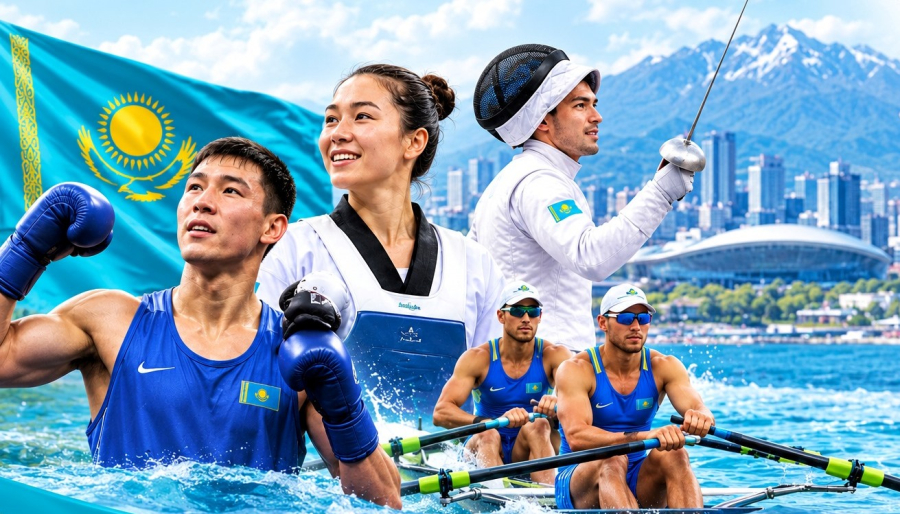
Kazakhstan finished the 2026 Asian Games in Aichi-Nagoya with 84 medals, including 12 gold, 24 silver and 48 bronze. The result put the country eighth in the overall medal standings – three places higher than at the previous Games in Hangzhou in 2023, 24KZ reports.
For Kazakhstan, however, the significance of the 2026 campaign goes beyond the final medal count. The Games brought historic victories in several Olympic sports, a long-awaited return to the top of the Asian boxing podium and a number of results that could shape the country’s sporting ambitions ahead of future international competitions.
From Hangzhou to Aichi-Nagoya
Kazakhstan arrived in Japan after finishing 11th at the 2023 Asian Games in Hangzhou, where the national team won 80 medals, including 10 gold, 22 silver and 48 bronze.
Three years later, the overall number of medals increased to 84. More importantly, Kazakhstan added two gold medals and moved up three positions in the final standings.
The country sent 558 athletes to Aichi-Nagoya, competing across 35 sports. The Asian Games brought together around 11,000 athletes from 45 countries, with 469 sets of medals contested across the programme.
The improvement was not driven by a single sport. Instead, Kazakhstan collected medals across a broad range of disciplines, while several teams and individual athletes reached milestones that had eluded the country for years.
Boxing makes its comeback
One of the most symbolic moments came in boxing.
For the first time since 2014, a Kazakh boxer won Asian Games gold. Torekhan Sabyrkhan defeated Jordan’s Zeyad Eashash by unanimous decision in the men’s 70kg final. It was Kazakhstan’s first boxing gold at the Asian Games in 12 years.
The success did not stop there. Team captain Aibek Oralbay also claimed gold in the over-90kg category, giving Kazakhstan two boxing champions at the Games.
For a country with a long-standing boxing tradition, the victories carried particular weight. Kazakhstan had traditionally been one of Asia’s leading boxing nations, but the country had not won a gold medal in the sport at the Asian Games since Incheon in 2014.
Aichi-Nagoya therefore marked a return to the top of the continental podium.
Gold after 24 years in fencing
Another breakthrough came in men's épée.
The Kazakhstan team of Ruslan Kurb anov, Kirill Prokhodov, Yerlik Sertai and Vadim Sharlaimov defeated South Korea 43–42 in a dramatic final.
The victory was Kazakhstan’s first Asian Games gold in men's team épée in 24 years. The achievement was particularly significant because the same Kazakh fencers had also established themselves among the world's leading teams, winning the world championship earlier in the year.
The final against South Korea was decided by just one point, underlining how narrow the margins were at the highest level of Asian competition.
A first for rowing – and a first for taekwondo
The Games also produced firsts for Kazakhstan in sports where the country had never previously won Asian Games gold.
Vladislav Yakovlev and Ivan Chernukhin secured Kazakhstan’s first Asian Games gold in rowing.
Tamirlan Tleules then made history in taekwondo, becoming the first Kazakh athlete to win an Asian Games gold medal in the sport. His victory came in the men's under-58kg category.
These victories broadened the picture of Kazakhstan's sporting strengths. The country's medal success was not limited to its traditionally strong disciplines such as boxing, wrestling and judo.
Cycling, karate and a familiar champion
Kazakhstan also made a strong start to the Games.
On the first full day of competition, the country won four gold medals. Rinat Sultanova and Alexey Lutsenko triumphed in cycling, while Zholaman Bigabyl and Sofia Berultseva won gold in karate.
Lutsenko added particular significance to the result by becoming a two-time champion at the 2026 Games.
The early success gave Kazakhstan momentum and demonstrated the depth of the national team across different disciplines.
Judo delivers consistency
Judo remained one of Kazakhstan's most productive sports in Aichi-Nagoya.
The national team reached four individual finals – through Yeldos Smetov, Abiba Abuzhakynova, Adilet Almat and Azhar Askhat — with all four athletes taking silver after losing to Japanese opponents.
Kazakhstan also won silver in the mixed team event, again finishing behind Japan.
The results highlighted both Kazakhstan's competitiveness and the strength of Japan's judo programme on home soil.
Abuzhakynova, meanwhile, continued her strong Asian Games record by reaching the final for the second time.
Wrestling, gymnastics and team sports add to the total
Kazakhstan's wrestling teams also improved their medal output.
The men's freestyle team won three bronze medals after returning from Hangzhou without a medal in the discipline. The women's team added one silver and two bronze medals, compared with one silver in 2023.
In artistic gymnastics, Milad Karimi won silver in the floor exercise. Kazakhstan returned to the podium in the event for the first time in 32 years.
The country's men's water polo team also reached the final, eventually taking silver after losing to Japan.
Kazakhstan's rhythmic gymnastics group won bronze, while tennis player Yulia Putintseva also claimed bronze in the women's competition.
Together, these results helped produce a total of 48 bronze medals – the same number Kazakhstan won in Hangzhou.
What the numbers say
The comparison with recent Asian Games shows a clear picture.
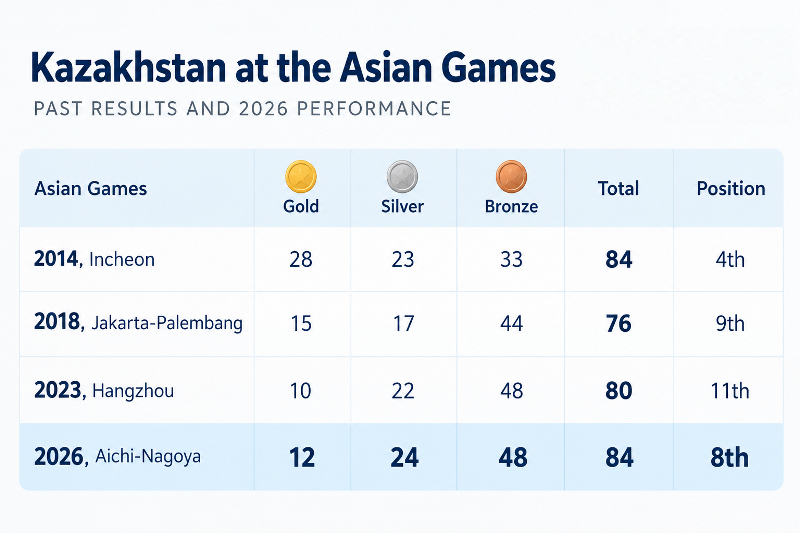
The 2014 Games remain a particularly high benchmark for Kazakhstan, with 28 gold medals and 84 medals overall. The following editions brought a gradual decline in the number of gold medals.
The 2026 result does not return Kazakhstan to the level of its 2014 campaign, but it does reverse part of the recent downward trend.
Compared with Hangzhou, Kazakhstan won four more medals overall, two more golds and moved from 11th to eighth place.
More than a medal table
The most interesting aspect of Kazakhstan's Aichi-Nagoya campaign may therefore be the combination of established strengths and new breakthroughs.
Boxing returned to the top after a 12-year wait. Fencing produced gold after a 24-year gap. Rowing and taekwondo delivered historic firsts. Cycling and karate provided early gold medals, while judo, wrestling, gymnastics and team sports added depth to the overall result.
Kazakhstan leaves Japan with 12 gold medals and 84 medals in total – but also with a wider group of sports capable of producing results on the continental stage.
The next Asian Games will be held in Doha in 2030. For Kazakhstan, the four-year period ahead will provide an opportunity to build on the progress seen in Aichi-Nagoya and turn individual breakthroughs into a more consistent medal-winning system.
For now, the numbers tell a straightforward story: Kazakhstan has moved back into the top eight in Asia, increased its gold-medal haul and added several new chapters to its Asian Games history.