


Kazakhstan Explained: 10 Things to Know About Central Asia’s Largest Country
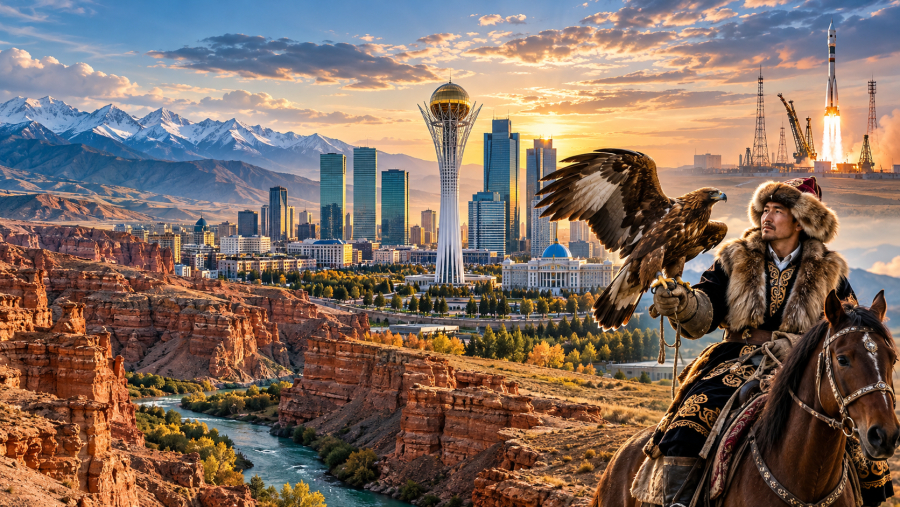
Kazakhstan is the world's ninth-largest country, the leading producer of uranium and home to the spaceport that launched the first human into orbit. It also sits along a major trade route between China and Europe. Yet despite its size and economic importance, much of the country remains unfamiliar to international audiences. Here are 10 things worth knowing about Kazakhstan.
Kazakhstan is bigger than you might think
Kazakhstan covers 2.7 million square kilometres, making it the ninth-largest country in the world and the largest landlocked nation.
It is larger than France, Germany, Spain and Italy combined, yet has a population of just over 20 million. Much of its territory consists of open steppe, deserts and semi-desert landscapes, although the country also has forests, lakes and mountain ranges.
The distance from Kazakhstan's western border to its easternmost point is roughly 3,000 kilometres.
For centuries, this vast territory was home to nomadic communities whose livelihoods depended on livestock and seasonal migration. Today, Kazakhstan's size creates both opportunities and challenges, from developing transport networks to connecting remote communities.
Kazakhstan is both European and Asian
Most of Kazakhstan lies in Central Asia, but a small part of its territory extends west of the Ural River into geographical Europe.
The country borders Russia, China, Kyrgyzstan, Uzbekistan and Turkmenistan. It also has a coastline along the Caspian Sea, despite having no direct access to the world's oceans.
That geography helps explain Kazakhstan's growing role in international trade.
Railways across the country connect China with markets further west. One of the routes attracting attention is the Middle Corridor, which links China and Europe through Kazakhstan, the Caspian Sea and the South Caucasus.
Astana became the capital in 1997
Kazakhstan moved its capital from Almaty to Akmola in December 1997. The city was renamed Astana the following year.
Since then, Astana has developed a skyline of government buildings, glass towers and distinctive architectural landmarks, including Baiterek Tower and the Palace of Peace and Reconciliation.
Its climate is less welcoming than its modern appearance might suggest. Winter temperatures can fall below minus 30 degrees Celsius.
Almaty, the former capital, remains Kazakhstan's largest city and a centre of business, culture and education. Located near the Tian Shan mountains, it offers a striking contrast to Astana's flat steppe surroundings.
Kazakhstan leads the world in uranium production
Kazakhstan is the world's largest uranium producer, supplying around two-fifths of global mine production in recent years.
Uranium is used as fuel in nuclear power plants, making the country an important supplier to the international energy industry.
But uranium is only part of Kazakhstan's resource economy.
The country also has substantial oil and gas reserves, including major fields such as Tengiz, Kashagan and Karachaganak. Copper, zinc, chromium and coal are among its other mineral resources.
Energy and mining have helped finance Kazakhstan's development, but they also leave the economy exposed to fluctuations in global commodity prices.
Kazakhstan wants to build an economy beyond oil
Kazakhstan's technology industry is expanding, although oil and other natural resources still dominate much of its export economy.
According to the World Bank, the country's ICT service exports rose from $132 million in 2019 to $1.1 billion in 2025.
Astana Hub, a technology park and startup platform, supports companies developing software and digital products.
Artificial intelligence has also become a policy priority.
In September 2026, the World Bank approved a $75 million loan for the ALEM project, which aims to expand AI training, improve access to computing infrastructure and support technology startups.
The challenge is turning these programmes into companies that can compete internationally and create sustainable jobs.
Kazakhstan is part of a growing trade route between China and Europe
Kazakhstan has no direct access to the world's oceans, but its railways connect China with Europe.
One route gaining attention is the Trans-Caspian International Transport Route, better known as the Middle Corridor.
Cargo travels across Kazakhstan, crosses the Caspian Sea to Azerbaijan and continues through Georgia towards European markets.
The route offers an alternative to northern overland connections through Russia, but it also faces practical difficulties.
Limited port capacity, shipping schedules, border procedures and the need to coordinate transport across several countries can increase costs and delays.
Investment in railways, ports and logistics infrastructure could help make the corridor more competitive.
Horses and nomadic traditions remain part of Kazakh culture
Horses have shaped life on the Kazakh steppe for centuries. They were essential for transport, livestock herding and warfare, and remain closely associated with national identity.
Traditional practices such as eagle hunting, horseback games and dombra music continue to be celebrated.
The yurt, a portable dwelling used by nomadic communities, remains an important cultural symbol.
Food also reflects the country's pastoral history. Beshbarmak, traditionally made with boiled meat and dough, is one of Kazakhstan's best-known dishes.
Nauryz, celebrated in March, marks the arrival of spring and is one of the country's most important holidays.
These traditions are not confined to museums. They remain visible at family celebrations, cultural festivals and sporting events.
Kazakhstan has two widely used languages
Kazakh is the state language, while Russian is also widely used in business, public life and everyday communication.
Many people speak both languages, although usage varies by region, generation and social setting.
Kazakhstan is also home to Uzbek, Uyghur, Ukrainian, German, Korean and other communities.
The country's diversity reflects centuries of migration and major population movements during the Soviet period.
English is increasingly used in international business, technology and higher education, particularly in major cities.
The first human journey into space began in Kazakhstan
On April 12, 1961, Yuri Gagarin became the first human to travel into space.
His Vostok 1 spacecraft launched from Baikonur Cosmodrome in what was then the Kazakh Soviet Socialist Republic.
Four years earlier, the world's first artificial satellite, Sputnik 1, had also been launched from Baikonur.
Built during the Soviet era, the cosmodrome remains an important part of the history of space exploration.
Today, Baikonur continues to operate under arrangements between Kazakhstan and Russia, while Kazakhstan has developed its own satellite programmes.
Kazakhstan is looking beyond its traditional industries
Kazakhstan is already a major supplier of uranium, oil and other natural resources. The question now is whether it can develop new sources of growth.
The government is investing in digital services, artificial intelligence, transport infrastructure and education. The country is also seeking to attract international companies and expand its technology exports.
Progress will depend on more than investment announcements. Access to skilled workers, competitive markets, reliable infrastructure and private financing will shape how far these ambitions can go.
Kazakhstan's geographical position has long connected different parts of Eurasia. Its next challenge is to turn that advantage, alongside its growing technology sector, into broader economic opportunities.