
Kazakhstan's Middle Corridor Role Grows as World Bank Outlines Trade Potential
Investment in the Middle Corridor, a trade route linking China and Europe through Kazakhstan and the Caspian Sea, could more than triple trade volumes and create two million additional jobs across nine countries by 2040, according to a new World Bank report, 24KZ reports.
The report, released on September 28, says improvements to railways, ports and logistics services could halve transport times and increase GDP across the corridor economies by 3.3%. The projected gains depend on coordinated investment and reforms to make cross-border freight services more efficient. Under a more ambitious scenario, freight volumes could quadruple and journey times fall by as much as two-thirds compared with 2023. The forecasts cover nine countries, including Kazakhstan, Azerbaijan, Georgia and Türkiye. They are not projections for Kazakhstan alone.
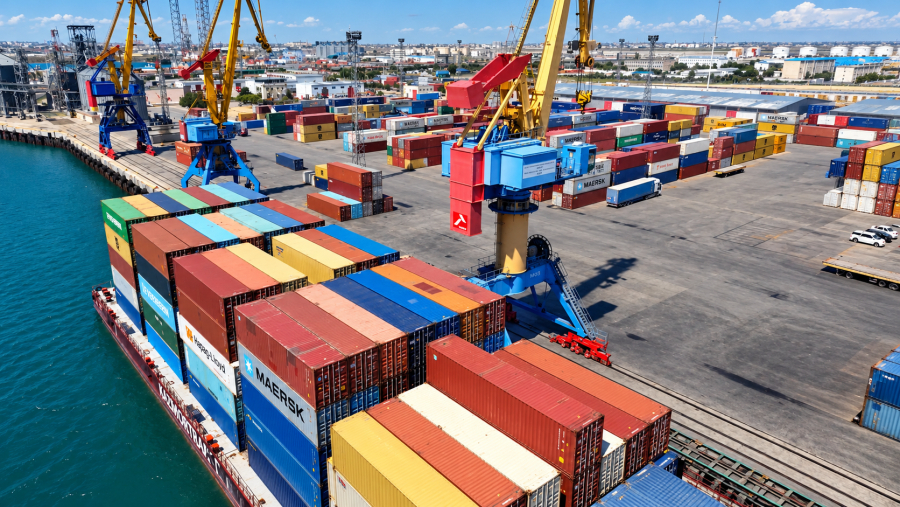
The Trans-Caspian Transport Corridor, also known as the Middle Corridor, connects China with European markets through Central Asia, the Caspian Sea and the South Caucasus. Kazakhstan is a key section of the route. Freight entering the country from China travels west by rail to the Caspian ports of Aktau and Kuryk. It is then shipped to Azerbaijan before continuing towards Georgia, Türkiye and European destinations. The route offers an alternative to northern overland connections through Russia, but its reliance on both rail and sea transport creates logistical challenges. Cargo must pass through several borders and transfer between different transport operators, making delivery times dependent on port capacity, customs procedures and shipping schedules.
Freight volumes along the Middle Corridor exceeded three million tonnes in the first eight months of 2026, up 22% from the same period last year, according to figures cited by Kazakhstan's Vice Minister of Trade and Integration, Aidar Abildabekov. The increase follows a decline in overall traffic in 2025. Freight volumes fell from 4.48 million tonnes in 2024 to 4.12 million tonnes last year, according to figures reported by Kazinform. Container traffic moved in the opposite direction, rising 36% in 2025 to approximately 77,000 twenty-foot equivalent units (TEUs). The figures point to growing demand for container services, although overall freight volumes have fluctuated.
The World Bank estimates that at least $25 billion will be required to upgrade physical infrastructure along the corridor by 2040. Investment priorities include railway capacity, ports and maritime connections. A further $30 billion is estimated to be needed for supporting infrastructure and services, including logistics centres, connecting roads, freight equipment and digital systems. Several major projects are already under way or in preparation. In Kazakhstan, railway upgrades and improvements to Caspian port facilities are intended to increase capacity and ease congestion. But the World Bank warns that new infrastructure alone will not make the route competitive. Delays at border crossings, inconsistent shipping schedules and fragmented documentation can undermine improvements elsewhere in the transport network.
The report calls for a single digital system to manage transport, transit and trade documentation across the corridor. It also recommends closer integration between railway and shipping operators, potentially through a joint venture providing coordinated container services.
Better cooperation could reduce delays and make delivery times more predictable for businesses. The World Bank also recommends reforms to improve the efficiency and commercial performance of state-owned transport operators. "Realizing the corridor's full potential will depend on practical improvements that make freight movement faster, more predictable, and easier to manage across borders," said Charles Cormier, the World Bank's Regional Director of Infrastructure for Europe and Central Asia.
The World Bank estimates that investment and reforms could help generate two million additional jobs across the nine economies assessed in the report by 2040. The forecast reflects wider economic gains from improved trade connections, market access and investment. It does not refer solely to employment in transport and logistics. Kazakhstan and Türkiye, the largest economies in the group, are expected to see some of the biggest gains in absolute terms. For Kazakhstan, a more efficient corridor could support logistics businesses, attract investment and improve access to international markets for domestic producers. The route could also help the country diversify an economy that remains heavily dependent on oil, gas and other commodities.
However, the World Bank's projections depend on sustained investment, regulatory improvements and cooperation between governments and transport operators.
Whether the Middle Corridor becomes a competitive link between Asia and Europe will ultimately depend on its ability to offer businesses reliable delivery times and lower transport costs.