


Kazakhstan Calls for Common AI Standards in Newsrooms at Astana Media Week 2026
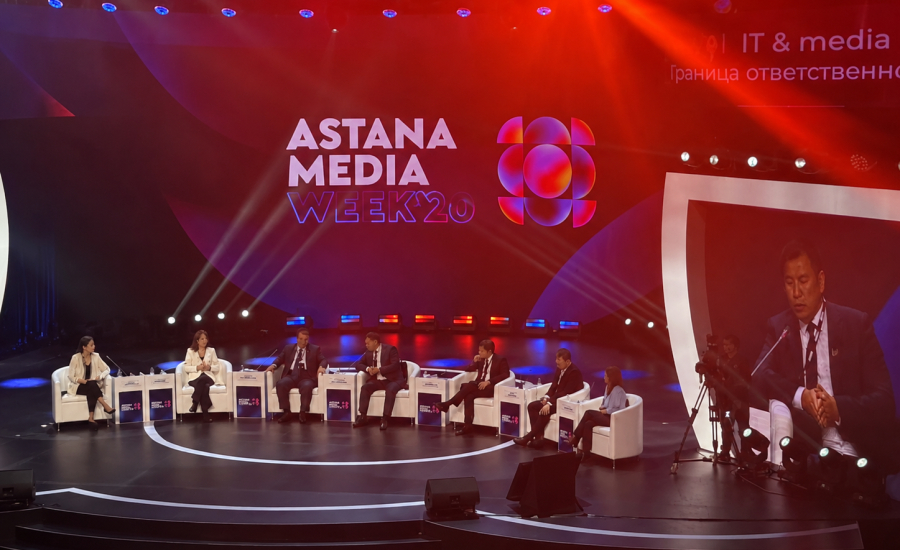
Kazakhstan is calling for common professional standards on the use of artificial intelligence in newsrooms as the country’s media industry adapts to changing audience habits and growing competition from digital platforms. The proposal was presented at Astana Media Week 2026, which opened in the capital on October 14, 24KZ reports.
The three-day forum brings together journalists, media executives, technology companies and international experts to discuss how artificial intelligence is reshaping news production, distribution and public trust.
Speaking at the opening, Kazakhstan’s First Vice Minister of Culture and Information, Kanat Iskakov, said that while AI can help newsrooms produce content faster, responsibility for accuracy and editorial decisions must remain with journalists.
“An algorithm can write a text, as we all understand, but it cannot take responsibility for its words. That responsibility always lies with the journalist and the newsroom as a whole,” Iskakov said.
He proposed that media organisations work together to develop common professional principles for using AI, rather than relying solely on rules imposed by regulators. The discussion also addressed transparency in AI-generated content. Iskakov stressed that audiences should be able to identify material produced with the assistance of artificial intelligence.
The issue has become increasingly important as AI-generated images, videos and voice recordings make misinformation more difficult to detect. Deepfakes involving public officials and journalists have raised concerns about the credibility of information circulating online.
The forum also highlighted how significantly Kazakhstan’s media industry has evolved over the past decade. According to figures presented by Iskakov, the number of registered media outlets has increased from approximately 2,900 to more than 5,400 over the past ten years. However, the growth in media organisations has been accompanied by major changes in how people access information.
Around 40% of Kazakhstan’s population now receives news through social media and messaging platforms, according to figures cited at the forum. These platforms have become important channels for news distribution, increasingly competing with traditional television broadcasters, newspapers and news websites. AI-powered services are also emerging as a new way for audiences to access information. Citing international research, Iskakov said the share of people using AI chatbots to obtain news at least once a week had increased from 7% to 10% over the past year. The figures point to a broader shift in news consumption, with audiences increasingly relying on digital platforms and AI-powered tools to find, summarise and understand current events.
Another major theme of Astana Media Week was the future of traditional media formats. Iskakov suggested that the distinction between television broadcasters, online publications and print media could gradually become less relevant as news organisations develop integrated digital operations.
Television channels are expanding their presence on streaming platforms and social media, while online publishers are increasingly producing video reports, interviews and live broadcasts. Artificial intelligence is accelerating this transformation by helping journalists process information, prepare content and adapt stories for different platforms. However, Iskakov emphasised that technological advances should not come at the expense of journalistic standards.
Regardless of how news reaches audiences, accuracy, editorial accountability and public trust remain essential to professional journalism. The international reach of Kazakhstan’s media industry is another focus of this year’s forum.
One of the sessions, Central Asia in English: Why Translation Alone Doesn’t Make Content Global, examines how regional news organisations can better engage international audiences. The discussion focuses on the challenges of producing English-language journalism that goes beyond direct translation, including selecting stories relevant to international readers, providing context and adapting editorial approaches to different markets. The session reflects growing interest among Central Asian media organisations in reaching audiences beyond the region and strengthening their presence in the global information landscape.
Astana Media Week 2026 is taking place from October 14 to 16 at the Palace of Peace and Reconciliation in Kazakhstan’s capital. This year’s theme, MEDIA. HUMAN. AI: 10 Years of Transformation. A New Architecture of Trust, reflects the growing influence of artificial intelligence on the media industry.
The programme includes discussions on digital security, AI in journalism, new business models, international content distribution and the future of newsrooms. Representatives of international companies and media organisations, including Meta, TikTok and Euronews, are among the announced participants.
The event will conclude on October 16 with the Qazaqstan Media Awards, recognising achievements across Kazakhstan’s media industry.